I Love a Parade!!

I’m linking up with Speech is Sweet for her weekly “Wild About Books Wednesday Linky Party!” Naturally, I’m a day late, but why not keep it going a little longer? I came upon this book by chance when I was purchasing a Thanksgiving book. You know how Amazon makes recommendations based on your purchases in the hopes of suckering you into buying more! I’m an easy sell! The book is titled “Balloons Over Broadway: The True Story of the Puppeteer of Macy’s Parade.” This year marks the 90th Macy’s Thanksgiving Day Parade and it is truly fascinating to read about how it all came to be. The creative genius behind the parade balloons is Tony Sarg, an immigrant marionette maker with remarkable vision.  The story chronicles how he transformed the Macy’s Thanksgiving Day Parade into the beloved annual extravaganza it has become.
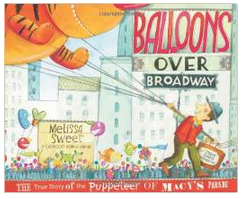
Available here

I love this book! It has a lexile of 1000 which is appropriate for grade 6 and beyond. The plot is extremely engaging and the illustrations are amazing. The author/illustrator creates mixed media collage illustrations that are interesting and captivating!

This is how I am using “Balloons Over Broadway” in our speech room:
  1. The tier 2 vocabulary is rich and robust.  You’ll find words like jostle, articulate, marionette, shimmy, sallied, flounce, rigged.
  2. Making predictions: as the subject of the story tinkers with how to offer a parade for the generations my students offered their suggestions.
  3. Problem solving: creative geniuses often run into problems or potential problems.  Balloons Over Broadway allowed my students to help Mr. Sarg solve his problems.
  4. Executive functions: After reading the book together, I asked students to work together to design and create their own rod puppets.  They aren’t finished yet, but I will post a picture on Instagram when they are complete!
  5. Balloons Over Broadway fits nicely with Social Studies as the impetus for the parade was to help Macy’s employees, many of whom were immigrants, feel more at home in America, as they were longing for their traditions.
  6. Comparisons:  We watched a video on YouTube of the 2013 Macy’s Thanksgiving Day Parade and compared with the original parade from 1924.
  7. Science:  I never thought about where helium comes from and recently learned in a science class that it is found in underground rock formations. Helium is also a by-product of drilling and processing natural gas. The United States even has a Federal Helium Reserve! Who knew?
  8. Writing: Using the Expanding Expression Tool by Sara L. Smith, students can summarize the book.  I have a poster with descriptions of the beads on Teacher Pay Teachers.  You can grab it for free by clicking HERE

I hope you check this book out and let me know if you love it as much as I do!
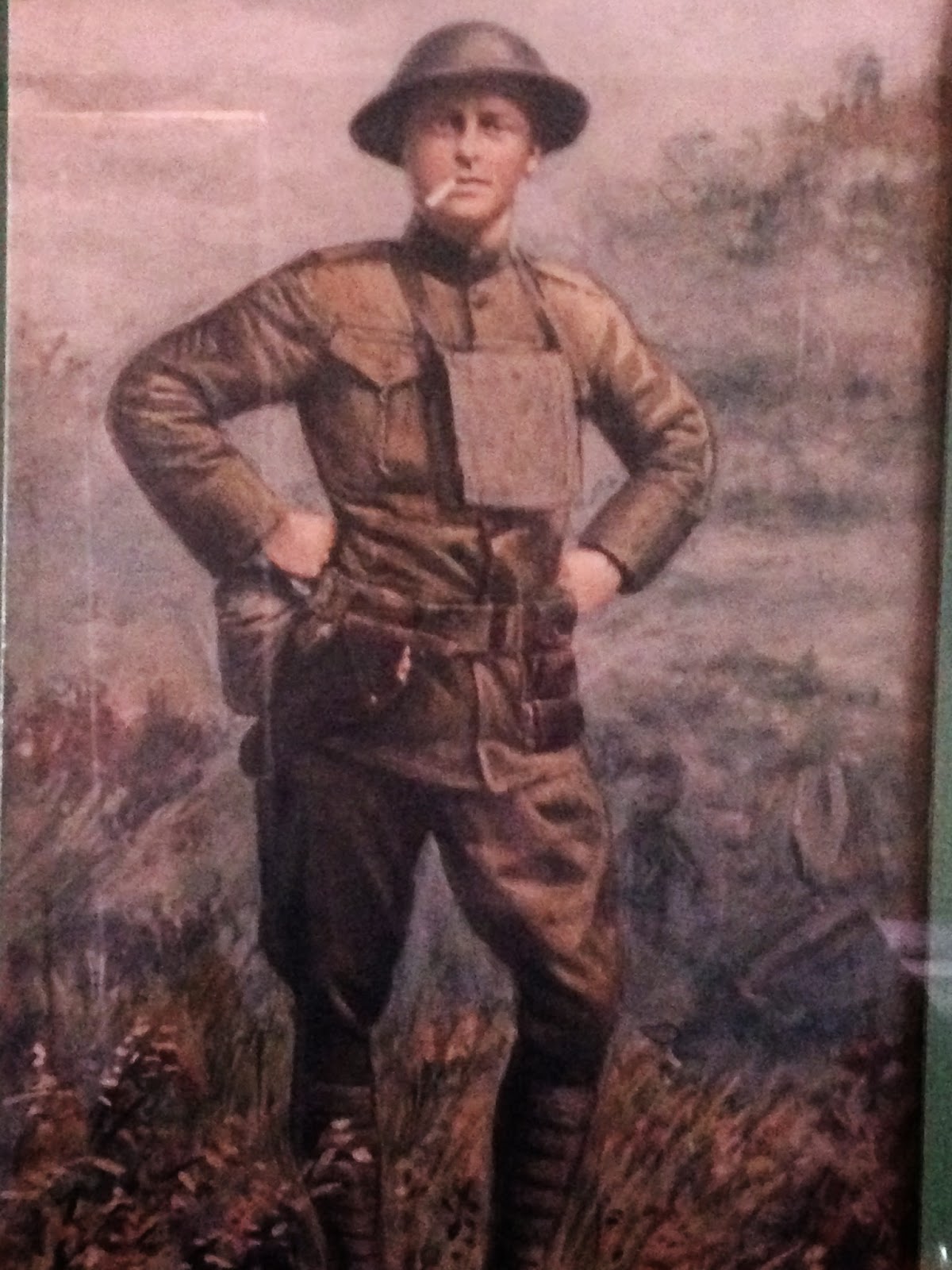
Lest We Forget

In 1979, at the ripe, old age of 18, I chose speech-language pathology as my area of study in college. I drove my brown 1973 Pontiac Ventura to classes everyday (three on the tree, by the way). I was a generally happy kid, gracefully shifting between studious young woman, drug store cashier, and quarters playing, weekend party animal. I graduated in 1983, and began my career at 22 years old as a speech-language pathologist. My first jobs were as an itinerant and part-time SLP in three or four different towns while also working as a cashier in both Food Town and Thrift Drug. That first year out of school I had nine W-2 forms at tax time!

I was able to choose a career and make my dream a reality with ease. I was free to go to college as a woman. I was not denied employment because of religious discrimination. I was not prohibited from driving a car or hanging out with my friends on the weekends. Why? Because brave men and women acted, so that my freedoms were protected.

While Veterans’ Day is a wonderful day off in the middle of November it is also an opportunity to remember the courageous and selfless actions of those who preserve the American dream. This week I don’t have a cute craftivity, fancy packet, or amazing book companion. I don’t have anything “speechie” at all. All I have is a short post paying tribute to the individuals who have sacrificed for the common good, so that I can live as fully as I choose. Let’s remember on November 11, 2014 the men and women who have willingly served to protect our freedoms.

“To us in America, the reflections of Armistice Day will be filled with solemn pride in the heroism of those who died in the country’s service and with gratitude for the victory, both because of the thing from which it has freed us and because of the opportunity it has given America to show her sympathy with peace and justice in the councils of the nations…” President Woodrow Wilson, November 1919.
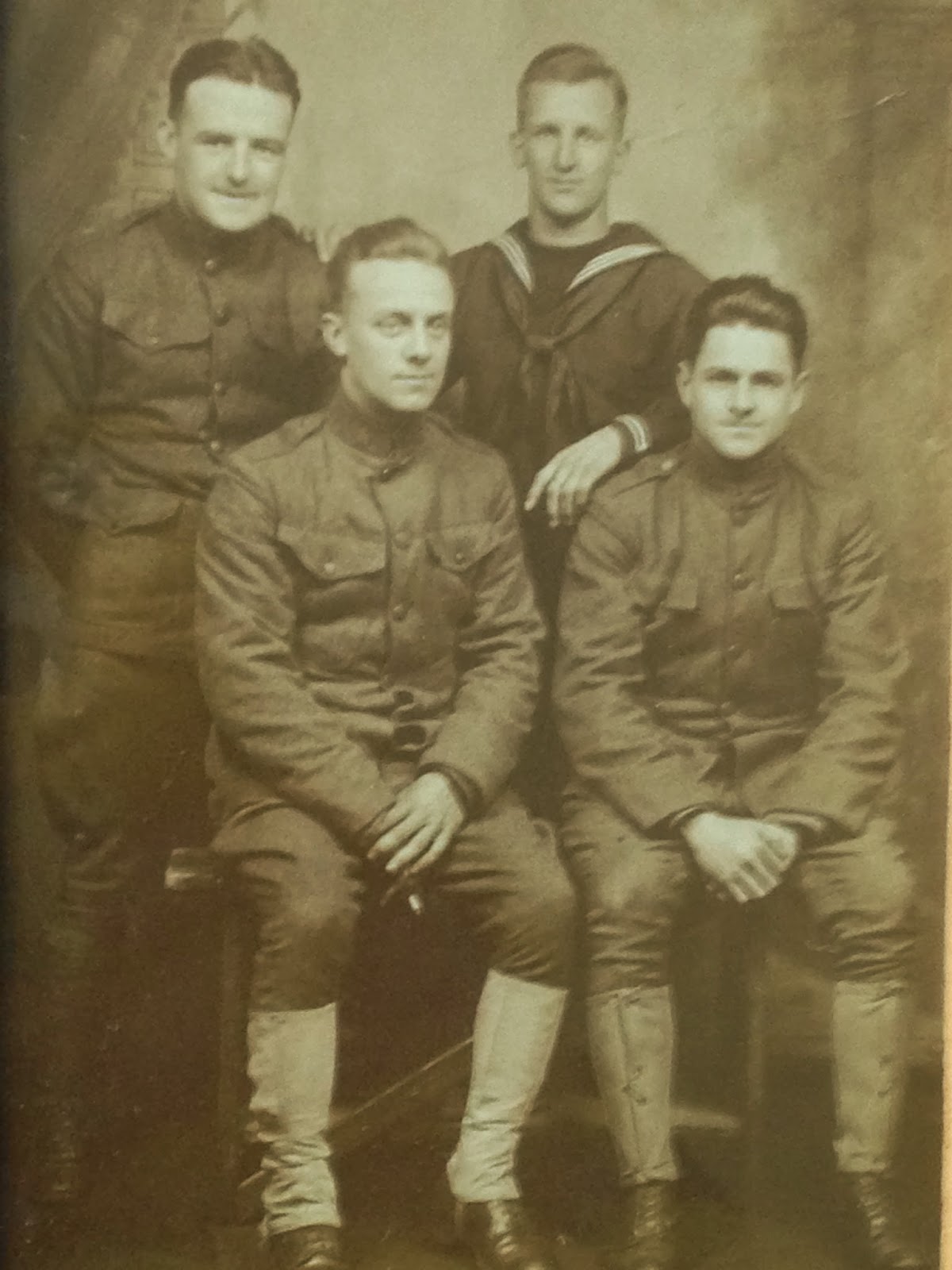
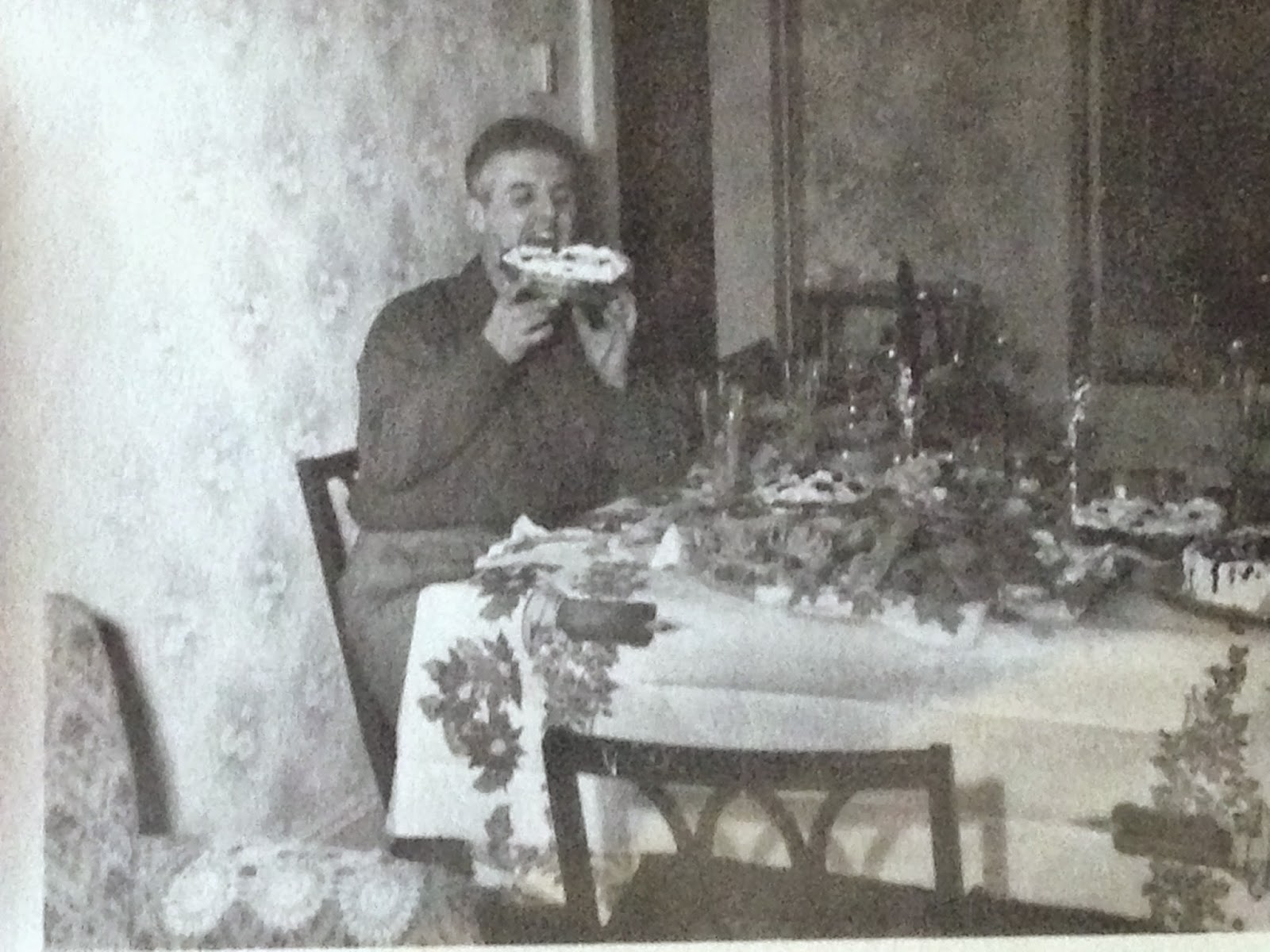
Thanks Dad, Pops, Pop, Ted and Doug!

Theodore Ruehl, my Pops

James Doyle, Jim’s Pop

August Polizzi my Dad

Doug, a hero

A Turkey for Thanksgiving

I’ve always felt that as one who works in a school, the days pass so quickly because I always have my eye on the next season or big holiday to theme my activities around. With Halloween a thing of the past, I’ve now set my sights on Thanksgiving. There are only fifteen (yes, fifteen) school days in the month of November. That doesn’t give me much time to use all the amazing materials and activities I have in my collection. I do have some tried and true activities that are my go to’s for the season and one book in particular I have been using for at least twenty years: A Turkey for Thanksgiving by Eve Bunting. It lends itself to some pretty amazing speech therapy. The illustrations, by Diane de Groat are so expressive and allow for considerable social pragmatic conversations. The text is rich with figurative language and tier two vocabulary. The dialogue between the characters incorporates many opportunities for abstract thinking. The story itself is a surprise for those who haven’t heard it before.

Since it’s evident this is one of my faves, I thought I would venture into some new territory and create a book companion (“Do one thing everyday that scares you”). I now realize why I buy book companions and don’t create them! Whew, it took me hours!!!!  Nevertheless, I’m satisfied with the result and I will be using it my own speech room.

http://www.teacherspayteachers.com/Product/A-Turkey-for-Thanksgiving-Book-Companion-1530067

I’m giving away a copy (another first that’s scary! Just love living on the edge…NOT!) Let’s hope it works 🙂
a Rafflecopter giveaway

One "StressLP" Rocking the Boat

Photo credit: Lois Metzger

It was a beautiful day. I woke up feeling well rested and eager to go to work. I felt completely prepared as I entered the building and even had time to connect with my colleagues in the teachers’ room over a cup of coffee. We laughed and shared stories of excellence in teaching and supportive administrators and parents. Some suggested we meet later in the day to collaborate on how to best implement a push-in lesson. A great start to a great day. I walked down the hall to my room meeting smile after smile. I grabbed my schedule and when the bell rang my first group was at my door ready for some top shelf speech-language therapy. Their homework was complete and they were eager to leave my room and use the skills we had addressed. When I met with their classroom teachers they asked how they could help reinforce the students’ speech-language skills in class. I had a preparation period next and since all my IEPs and evaluations were up to date I was able to work on my therapy plans for next week. I have a wealth of materials available all paid for by my school district and I realize how fortunate I am, and then…I woke up!
I am hesitant to write this post, because I ‘m not a whiner.  I am well aware of the fact that I am incredibly fortunate to have a job and I appreciate that. The problem is every day I read with sorrow, the posts by SLPs, young and old, who are overwhelmed. They are faced with staggering caseloads, paperwork burdens that threaten to smother them, shrinking budgets that cause them to spend their own hard earned money on supplies, professional isolation, and the list goes on. When I read about bright young SLPs, who are more talented and better educated than I, considering leaving the profession I have to ask, “Why?” When I read about a veteran SLP who weeps the first week of school because she feels powerless to help her students, I ask, “Why?” When I read of a young SLP who is reprimanded for having a pile of papers waiting to be sorted through, in the corner of a room, I ask, “Why?” I know first hand the effects of this stress on my well-being and that of my family. By the end of the week I have nothing left. I have to force myself to go out and socialize, because by Friday I am spent. I bring home evaluations to type, goals to write, and plans to create. Just yesterday the banter on Instagram was desks. One die-hard SLP was committed to keeping her desk neat and that spawned a dialogue of desk madness. My contribution included a lunch eaten at my desk over a period of hours. Last school year I was criticized for this and had to defend my actions by stating that a meeting had been scheduled during my lunch and rather than chowing in front of parents, I felt more comfortable at my desk.

Understand, there is no one person to blame for the situation facing SLPs. It is the system. Without legislation mandating caseload caps we will drown in a sea of paperwork. Without legislation that requires certification of SLPAs, districts will continue to hire individuals lacking the proper credentials who we are responsible for training and supervising. Without universities promoting the field and educating future SLPs we will continue to experience a critical shortage.
It has, unfortunately become our culture. We know each other by the bags we tote back and forth between school and home and the bags we sport below our eyes. We seek support for the abuses we face on social media and while we all try to hold the hand of the affronted SLP, we are still rendered powerless. We are on a quest to validate ourselves in the schools; emphasizing constantly that we are not just the speech teacher, that we are integral to the system, not simply part of an unfunded mandate. We have stormed social media with blogs and websites and tweets and photos. We are a huge presence on Teachers Pay Teachers and still we struggle.
I don’t pretend to have the answers, but I believe it is time to rally! I am convinced that we can effect a change. Many of us are members of teachers’ unions who should be advocating for our needs. How many SLPs are in administrative positions within the NEA or the AFT? ASHA needs to hear us and work for legislation that mandates caseload caps. Individually, we must get involved with our state associations and demand that the lobbyists we pay are actually working for us. There is power in numbers and I believe that we can change the status quo together.
I am still trying to do something everyday that scares me, and this post has been lurking in the back of my mind, but I was terrified to open myself up to the criticism. I then realized that that is part of the problem, I don’t want to rock the boat. Well, it’s time for me to rock. I for one am going to begin to advocate for my profession and myself. I am going to write to my legislators. I am going to contact my union. I am going to contact ASHA. I am going to do whatever I can to support my fellow Speech-Language Pathologists.  How about you?  Want to rock the boat?

#TrendingChatter

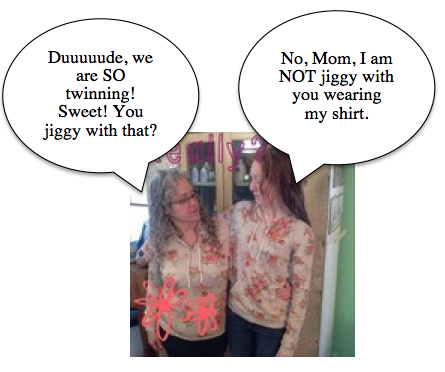
So. This is like, basically a short, fun Columbus Day post about trendy talk.  You know dude, the words kids pepper their conversation with ad nauseum. Years ago, it was basically, then about ten or so years ago it was actually.  What’s fun is literally, watching the terms used by adults.  I’m no exception. One of my twenty-something year old colleagues once schooled me on the proper way to enunciate dude. Apparently, I was stretching the syllable out far too long when it should have been a quick burst. I received a manicure once from a lovely fifty plus year old lady who concluded every sentence with “Cool. ” On any playground on any given day you can hear the phrases “awesome,” “you’re the bomb,” or “you rock”  escaping from the lips of the cool moms.  In the car one day I decided to have some fun (yes, at my kids’ expense) and announced that I was in fact jiggy with dat!   My children both exclaimed that I was never permitted to say that again!! Of course, I do whenever I want to be immature 🙂

I’ve noticed also that the overuse of these terms is common in our students with language impairments and social language difficulties. I worked with a Down Syndrome student who began every sentence with actually.  I have students with word finding difficulties who are using yeah as substitutions for elusive words.  In fact, recently one of my students used yeah four times in one sentence. Students with social pragmatic difficulties who call everyone dude are often the brunt of jokes from their classmates. That being said, in order to help facilitate more appropriate word choices I encourage my kiddos to record by tally each time the word in question is uttered. We are then able to use the total as a baseline and then brainstorm other word choices to create a more robust vocabulary. We establish a maximum number of uses per session and compare the numbers over time thus evaluating the fidelity of our technique, right.  Okay, look,  I suppose we in education are not free from the eduspeak lingo.  I do, however, try really, really hard not to use the jargon du jour. I want to stand out!  I want to be different. So, at the end of the day, I can rest assured that I have done my utmost to express myself in as clearly and succinctly a fashion as possible.  We SLPs really are the bomb.com!!
And now for some poetic dessert: a wonderful poem extolling the overuse of the word LIKE.

Sestina: Like

With a nod to Jonah Winter
Now we’re all “friends,” there is no love but Like,
A semi-demi goddess, something like
A reality-TV star look-alike,
Named Simile or Me Two. So we like
In order to be liked. It isn’t like
There’s Love or Hate now. Even plain “dislike”

Is frowned on: there’s no button for it. Like
Is something you can quantify: each “like”
You gather’s almost something money-like,
Token of virtual support. “Please like
This page to stamp out hunger.” And you’d like
To end hunger and climate change alike,
But it’s unlikely Like does diddly. Like
Just twiddles its unopposing thumbs-ups, like-
Wise props up scarecrow silences. “I’m like,
So OVER him,” I overhear. “But, like,
He doesn’t get it. Like, you know? He’s like
It’s all OK. Like I don’t even LIKE
Him anymore. Whatever. I’m all like … ”
Take “like” out of our chat, we’d all alike
Flounder, agape, gesticulating like
A foreign film sans subtitles, fall like
Dumb phones to mooted desuetude. Unlike
With other crutches, um, when we use “like,”
We’re not just buying time on credit: Like
Displaces other words; crowds, cuckoo-like,
Endangered hatchlings from the nest. (Click “like”
If you’re against extinction!) Like is like
Invasive zebra mussels, or it’s like
Those nutria-things, or kudzu, or belike
Redundant fast food franchises, each like
(More like) the next. Those poets who dislike
Inversions, archaisms, who just like
Plain English as she’s spoke — why isn’t “like”
Their (literally) every other word? I’d like
Us just to admit that’s what real speech is like.
But as you like, my friend. Yes, we’re alike,
How we pronounce, say, lichen, and dislike
Cancer and war. So like this page. Click Like.
Source: Poetry (May 2013).

Help for Itinerant Evaluators

I remember attending a conference at Stockton State College in NJ, back in the late 1980s or early 1990s presented by Dr. Wayne Secord.  I couldn’t tell you the topic, however, I do recall Dr. Secord saying something along the lines of “Today, multidisciplinary means come together-go apart when it should mean come together-stay together.”  That sentiment has remained with me all these years. At the time the truth of this struck me like a lightening bolt. Twenty-five or so years later, this idea, by and large, still rings true, though despite our best efforts, the time we need for collaboration is sadly limited. We are overwhelmed by staggering caseload numbers, case management responsibilities, massive paperwork requirements, meetings, playground duty and more. In concert with our general duties come more and more highly involved students presenting with academic and medical challenges that require the need for continuing education and research. Never has the need for consistent collaboration been more crucial.

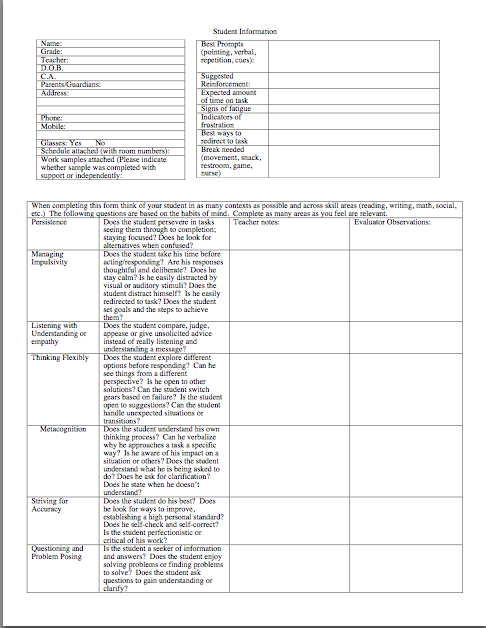
I am fortunate in that I work in one building.  I have the luxury of having a quick conversation on the run. I also have the benefit of knowing the students in my building, however, the inability to professionally connect becomes an issue when working as an itinerant SLP or evaluator. Recently, several of my colleagues expressed concern that itinerant evaluators may not have the inside scoop on students and subsequently their testing may not paint an accurate picture of our students. As a result, I decided to create a document that could be completed by a classroom teacher or case manager and given to an evaluator as a means of having a better understanding of the dynamics of a student.  I based some of the criteria on the Habits of Mind (HoM), but also included general information such as the types of prompting the student responds to best, preferred reinforcement, response speed, signs of fatigue or frustration, ways to redirect the student, whether breaks are needed and the preferred type of break. The document also includes demographic information and opportunities to incorporate work samples and class schedule.

The HoM present a way to think about the way students learn and are, to a large extent, a determinant in academic success or failure. The HoM include persistence, managing impulsivity, listening with understanding and empathy, thinking flexibly, metacognition, striving for accuracy, questioning, applying past knowledge, thinking and communicating with clarity,  gathering data through the senses, creating and imagining, responding with wonderment and awe, taking responsible risks, finding humor, thinking interdependently, and remaining open to continuous learning. Having an understanding of a child’s ability to manage impulsivity perhaps, or task persistence paints a more complete picture for an evaluator.  Such knowledge would allow an evaluator to say, schedule movement breaks or encourage a child to take risks when responding.  The upshot is, the information obtained could yield more accurate test results. I am hoping that this document provides evaluators with greater insight when interpreting test results as well as improving the accuracy of those results.

 I’d love to know what you think! Feel free to comment.

Student Information for Evaluators available for free here
 Find this PDF here
Habits of mind PDF available here

Apples, Pumpkins, and Leaves, Oh My

I love autumn! I think it is safe to say it is my favorite season. It awes my senses.  The crimsons and yellows, oranges and rust colored “foilage” (apologies to my SLP friends;
a nod to one of my autumnal mispronunciation pet peeves) blanket the ground like confetti.  I love the cool crisp air that snaps at my face. As I walk in the woods the song of the crickets and the pelting of acorns eases my addled mind.  And oh, the tastes; warm “cinnamony” apple crisp, savory stuffing, maple and buttery acorn squash.
With autumn comes some of my favorite speech and language activities, too.  I get some serious mileage out of apples and pumpkins and then of course there is Halloween.  It seems as my age increases my energy and creativity decreases.  I have the utmost respect for my incredibly talented colleagues who whip up some of the most clever and brilliant ideas.  I will say that now and again I have a little burst of creativity. Allow me to share few little items I’ll be pulling out this month.

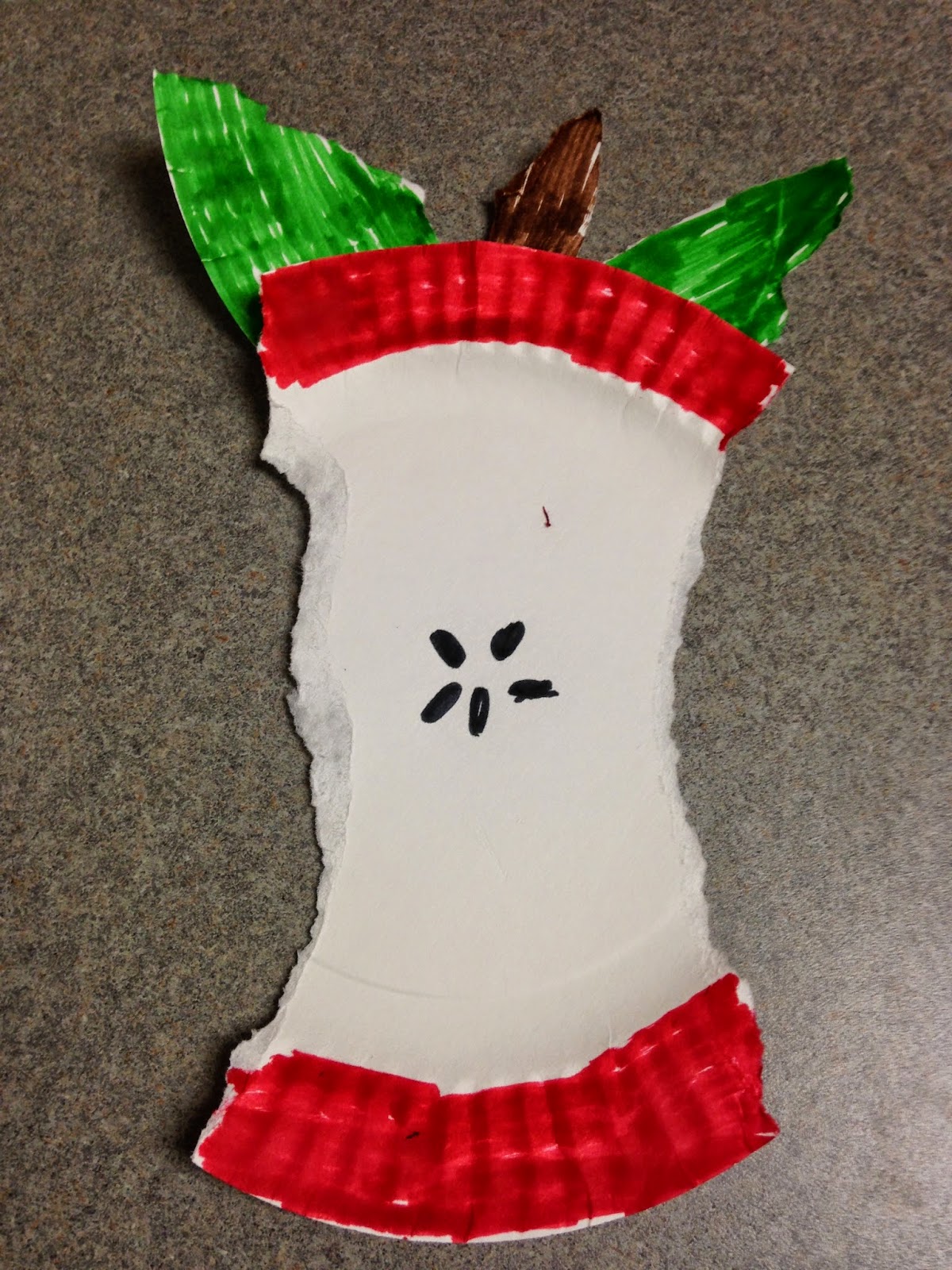
First of all, SquidjellySLP instagrammed the most adorable activity that I promptly “speech-lifted,” (I think I may have coined a new term).  Look at this sweet apple craft!
After picking up some iced coffee last week I repurposed the cup carrier to be used for positive reinforcement with any speech-language activity. Add a little paint and some googly eyes and I have a fun and versatile game. Just bounce an EYEball and see where it lands!
It was still summer when I started thinking about Halloween activities.  I found these creepy hands at Michael’s and thought they would be fun to hold cards or rake in little trinkets as reinforcement.
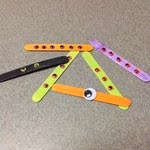
I love to use pacing sticks.  They are so helpful to my students with apraxia.  It’s fun to have a variety of pacing sticks corresponding to the seasons and holidays.  What better way than to make Halloween pacing sticks than with googly eyes (they just keep looking at me).
Oh the dollar store; the wonderful, wonderful dollar store.  I recently found these pumpkin parts. They will be perfect for use with some foam pumpkins I purchased several years ago. They have applications for vocabulary development with my little ones, describing, following verbal directions, comparing and contrasting, sentence formulation and so much more!
I hope you enjoy these suggestions and if you have any ideas you’d like to share I would love to hear about them.  Please comment and let me know what you’re planning this autumn!  Also follow me on Instagram (anniedoyle226), I’m sure to be adding some more activities as the season goes on.

Because I'm "Appy"

Over the years I have become increasingly dismayed about the state of mental health services in this country.  I come to this conclusion authentically after witnessing those with mental illness suffer in different ways.  Often diagnosis comes late, and then, rather than good treatment, experimentation with a series of medications ensues.  Medications  that either make one feel flat, cause them to gain weight, or even, cause panic attacks.  Certainly, I understand that in many cases medication is necessary and appropriate, however, in large part good therapy can be more effective than meds.  As an individual on a lifelong journey of improvement I have recently been acquiring skills that have not only allowed me to effectively deal with whatever life happens to throw at me, but have put me on the road to contentment.  It has also become abundantly clear that what I am learning and practicing are skills that I can also apply to my work with students around social.

Available here

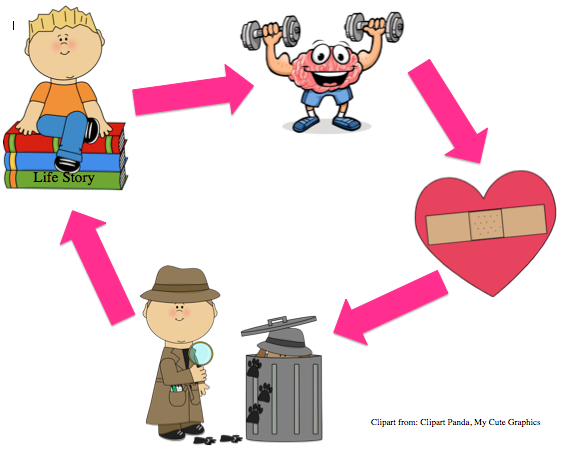
In most instances we enter the world emotionally sound.  As we grow our experiences, both good and not so good, shape what we think and feel and thus how we respond behaviorally.  It’s a fairly simple cycle: experience, thought, feeling, behavior.  I started to look at this cycle in terms of the students I see for social-pragmatic work. Sadly, I can’t change their negative experiences and I certainly can’t tell them to feel differently based on their experiences.  My goal is to help them learn to modify their behaviors and respond in a more positive and socially appropriate fashion. What’s left?  The thought. What I can do is help my students to reframe their thinking before becoming emotionally heightened and acting out.  I have used the graphic on the left to depict the cycle and provide an easy visual for my students.  Previously I’ve written about a workshop presented by Erik X. Raj.  It was a fabulous presentation on how to use the iPad in our work with students. One of the apps he discussed has a perfect “application” for helping students reframe thoughts.  ChatterPix Kids allows you to turn screenshots or photos  into “talkies” simply by tracing a line on the picture and recording.

Download in iTunes

I’ve used ChatterPix in conjunction with Michelle Garcia Winner’s Unthinkables (available here) to help students practice reframing a typical thought/response to a situation.  Using the ChatterPix Kids
App and a screenshot of the Unthinkable, students record a typical unthinkable-like response.  The Unthinkable comes to life! Next I have the students reframe the statement using a screenshot of a brain, emphasizing flexible thinking. The possibilities are endless.  Here are two examples of how we used ChatterPix Kids; one is a middle school student and one is a fourth grade student.

We have had quite a bit of fun using ChatterPix, particularly when addressing social language skills. Naturally, transfer of these skills requires consistent practice and reinforcement, nevertheless using a bent that is fun and different makes it all much more palatable.
How do you use the iPad for social thinking?  Let me know, I’m always on the search for new ideas and have fun!

To Intervention and Beyond!

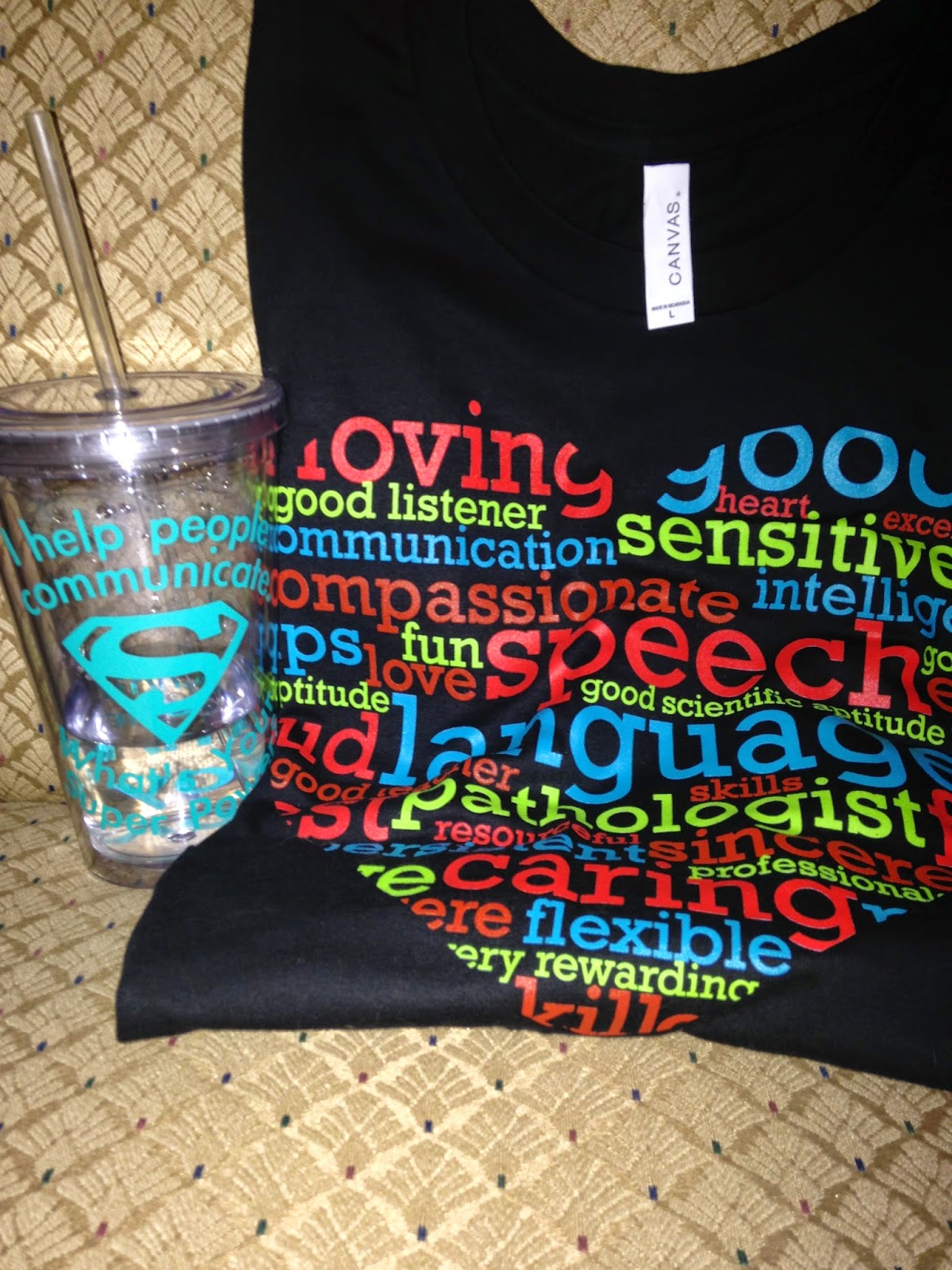
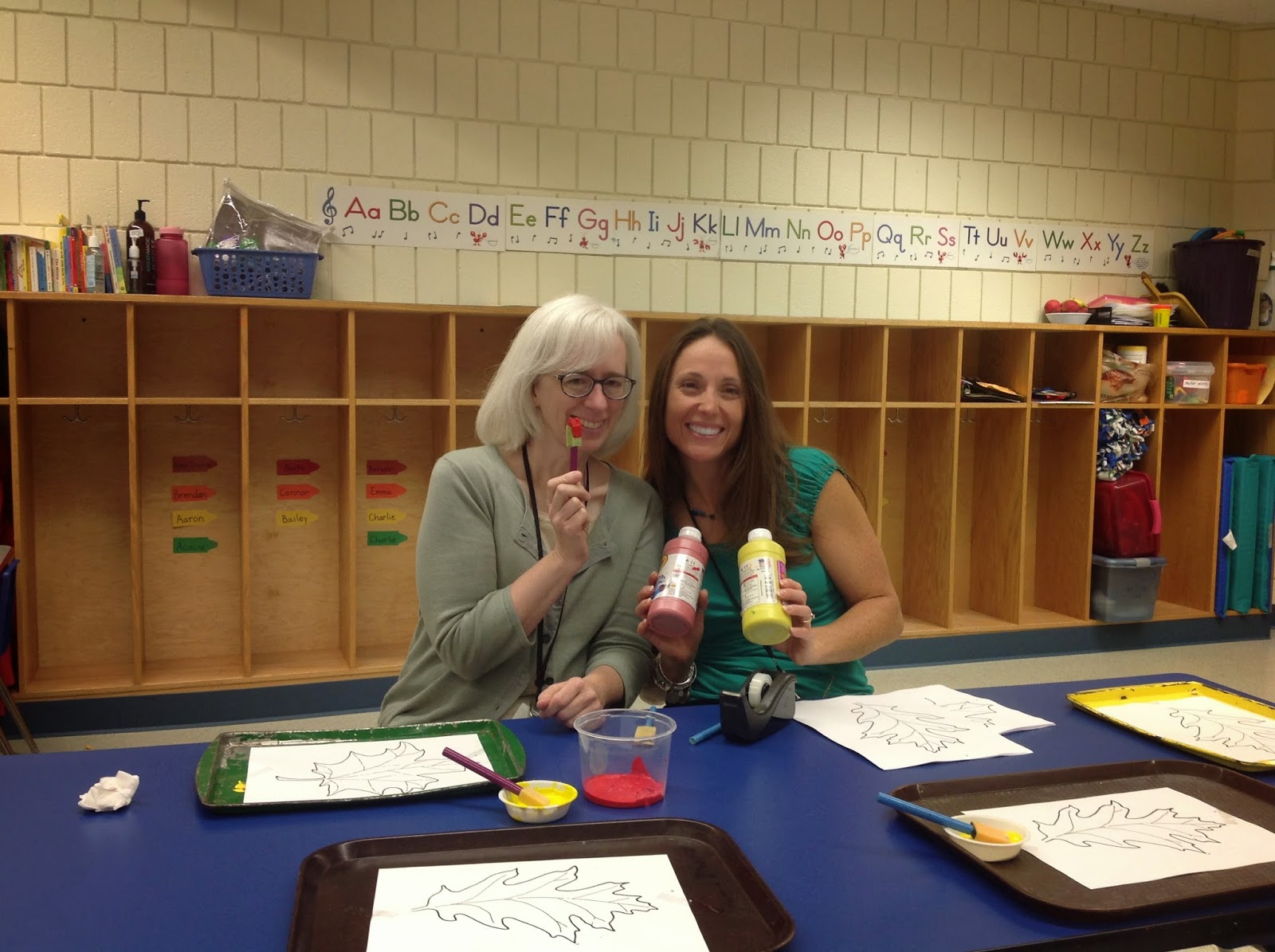
Wow!  There is so much speech-language merchandise available for purchase these days!  Most of the merchandise extols the superhuman qualities we as speech-language pathologists possess!  Some days I will admit, I feel the effects of the proverbial kryptonite and my powers are sapped.  Those are the days I seek out the superhuman strength of my amazing colleagues.  We joke in our family that “it takes a village to raise a Doyle,” and that includes me!  My amazing colleagues generously provide me with professional information, comic relief, a shoulder to cry on, fashion and family advice, exercise buddies, companionship and so much more.

from L to R: Beth, PT extraordinaire,
me (on a bad hair day),
Allison, a very special, special educator

As a public school SLP I provide speech and language intervention. Intervention is defined as “action taken to improve a situation,” and certainly that is what we do as speech-language pathologists.  Yet, it takes a village for us to do our jobs well and there are many “interventionists” who are in the trenches with us.  As I thought about the professional community that helps me each day, I wondered, “What would be possible if I tried to broaden my connections?”  Eureka! The New Hampshire Interventionist Collaborative was born. This really beats the original name: North Country Related Services and Special Educators Collaborative, (whew, that was a mouthful)!  Our group includes anyone who works together to improve the lives of the individuals they serve; SLPs, special educators, OTs, PTs, and SLPAs.

Our collaborative was initiated in April when we held our inaugural conference presented by the gifted and entertaining Erik X. Raj.  We were able to offer a full day workshop in beautiful Plymouth, NH. The workshop was close to home, affordable, and relevant.  The event was well received and the participants expressed a desire to continue our affiliation.  I am in the process of coordinating a fall speaker event that includes a discussion about the vision for our collaborative.

PK beauties Carol and Stacy

So do you ever feel professionally isolated?  Why not reach out to those in your area and start your own collaborative. The beauty of it is, it can be whatever you want it to be. It can be large or small. You can meet once a month or once a year. Pretty exciting, right?My hope is that our group can meet periodically, not just for continuing education, but to serve as a think tank, idea exchange, and volunteer network.  I know, lofty goals, but why not?  We’re super powered!

(Thank you NoDo for the title)!

Un-Social Media?

I really have fun with social media.  My platform of preference is Instagram; it’s fun, it’s a quick share, and it doesn’t afford opportunities for ranting.  I post to Facebook intermittently and I tweet infrequently.  It all can be fairly overwhelming.

While on the surface, it seems social media has connected us, in my humble opinion, it has disconnected us. We’ve all seen it; a family out to dinner.  The little one is watching a movie, as another is playing a game on the phone. The teen is texting a friend, and mom and dad aren’t talking. In our family, we have an unstated rule, when we are out to eat, no media! We talk and we laugh (Annie Doyle likes this).

I know I am not alone in being concerned that media, in particular social media is negatively impacting communication.  I haven’t grown up with social media.  In fact, I remember when we first went “online,” I was terrified.  I recall chat rooms that could be pretty dicey. I also remember the thrill when I heard the classic “You have mail.” Who me?  Today, I err on the side of caution. I make it a point not to have any online “friendships” with my students, their parents, the children of my friends, or my children’s friends, so I really don’t know what they are posting about. I have heard tragic stories of social media run amok and it is disturbing. We, as parents of teens, have access to our children’s passwords and they know we DO check. We are steadfast in our roles as parents and know our children are not always happy about our “meddling,” but it’s a scary world.

I also am aware of the effect social media has had on me. I have made some wonderful connections via the Instagram and blogging world and I am so grateful for that. I have reconnected with friends from thirty years ago. There also have been times I’ve been consumed with social networking. Never has this been more apparent than since I have started blogging. I have asked myself: “Do I really have 15 followers? Woohoo!!” “How many page views today?” “Why won’t so and so acknowledge my posts/efforts?” I have experienced emotional contagion whereby I have felt the emotions of others after viewing a posted video of the homeless or a mother singing to her dying daughter. I’ve read with disdain political rantings and ad hominem attacks made without the need for civilized discourse. As an adult I can choose to ignore these posts, block the author, or unfriend individuals who use Facebook as a sounding board. Middle school and high school students, whose social life incorporates social networks, may not have the wherewithal to to do the same.

What follows is just a brainstorm of the possible problems our students might “face” when using social media.
Over-sharing: Many people become turned off by posts documenting every moment of everyday.
Impulsive posting: Posts that are written when hurt or angry.
Confidence killers: So many gauge their popularity by the number of friends they have or the number of likes a post receives.
Misinterpretation of posts: This happens so frequently. We can’t know the tone of voice without hearing it and we don’t know the intent with which posts are written.
Misperception of our posts: Likewise others don’t have the benefit of knowing our intent.
Bullying: The internet is rife with opportunities for harassment. Individuals are so often emboldened by the cover of anonymity.
Feeling alienated: What is it about that “like” button? We are all too aware of who likes our posts and who ignores them and many are easily hurt by the passive-aggressive nature of “not liking.”
Macy’s window:  When a post is out there, it is out there forever. It’s like standing in Macy’s window for all to see.
FOMO (fear of missing out): Kids often feel left out and alienated when they see posts of friends doing fun things and they aren’t included. As a kid who wants to belong, there is often nothing worse than feeling excluded.
Ranting: Tirades are off-putting!
Attention getting: Kids are needy and social media is the perfect outlet for posting for attention. Positive or negative, attention is attention and meets the same need.
Not being in the moment: I have seen more people stop enjoying the moment to post a picture to Facebook or Instagram (guilty).
Time blackhole: Why waste time texting, waiting for a response, texting again…?
Disingenuous posts: Kids can post without honoring what they are really feeling. There have been sad stories of kids who have shared seemingly happy posts all the while hiding deep sadness.
What’s missing: At least 80% of our communication is conveyed through tone of voice and body language, so while we may seem connected there is an awful lot we are missing.

As communication gurus we can help our older students not get caught in the social media quagmire. Let’s collectively encourage our students to have a healthy relationship with social media. Let’s work toward being models who use social media to improve the world we live in, to disseminate quality information, to learn, and to spread joy.
For instance, let’s all consider the following, and teach our students as well, to…

  • Read and reread posts, text messages, and emails and if there is a nagging feeling that says, “Don’t post,” trust those instincts.
  • Don’t put stock in the number of likes on a post; it really is meaningless and what counts is the sharing of a valuable moment or idea. 
  • Don’t post controversial material: try to keep it happy, as social media is no place for political tirades.  If feeling compelled to make a point, do it respectfully and without profanity and hurtfulness.
  • Turn off notifications.  It can make you crazy.
  • Make efforts to engage in face to face conversation or at least the telephone.  Allow yourself to key into tone of voice and body language. When firming up plans, how about a real conversation? Just pick up the phone for Pete’s sake!
  • Don’t over-share.  People don’t really want a play by play of your day by day.
  • Be sure that what you post is a reflection of what you truly believe or feel.  Be genuine and if you need help ask for it. In this day and age no one should suffer alone.
  • Learn to take posts at face value. Without a conversation you can only guess what the intent or motivation of another is.
  • Don’t post when you are emotionally charged, you will regret it.
  • Live in the moment: when doing something fun don’t stop what you’re doing to post. Wait until the activity is finished and then share.

In addition, SLPrunner has a wonderful product I’ve used with great success targeting online safety, judgment and perspective taking.  You can find it here.

I would love to hear your thoughts on social media and communication.  Please share any of your awesome ideas for encouraging safe social media practices.